
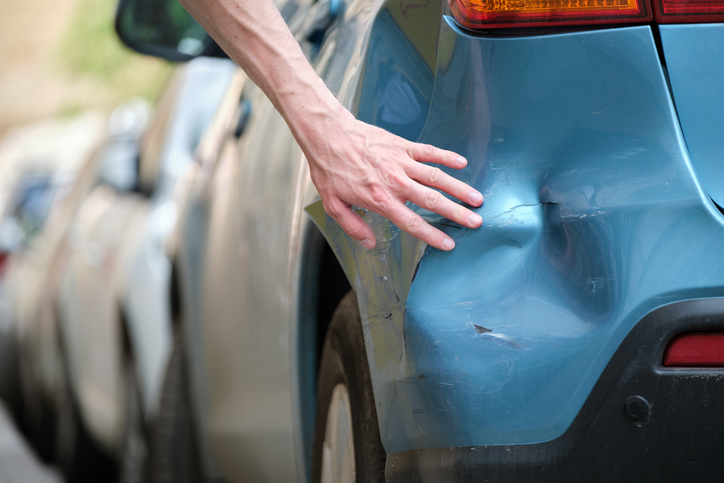
Usually your own insurance company pays for a hit and run through your uninsured motorist coverage. If police identify the driver who left, their liability insurance pays, but most hit-and-run drivers are never found, and Georgia treats an unknown driver the same as an uninsured one.
Making that claim has conditions, and one of them surprises people. A Tucker car accident lawyer can tell you quickly whether your accident meets them.
Who pays if the driver is never found?
Your UM coverage, if the claim clears one requirement. Under O.C.G.A. § 33-7-11, when the driver is unknown, actual physical contact has to have occurred between their vehicle and you or your car.
Here’s the part most drivers don’t know: physical contact isn’t required if your description of what happened “is corroborated by an eyewitness to the occurrence other than the claimant.” So if a car ran you off the road without touching you and a bystander saw it, you can still file a claim for damages like medical bills, lost wages, and vehicle damage. Without that witness, the same accident goes nowhere.
Georgia also lets you choose a property damage deductible of $250, $500, or $1,000 on UM coverage, so check yours before you assume the repair is fully covered.
What you do at the scene decides whether that works
Because the claim can turn on a witness, the first ten minutes matter more here than in an ordinary crash.
- Call the police. Georgia requires immediate notice, by the quickest means of communication, of any crash with injury, death, or apparent property damage of $500.00 or more. Your own policy will also have a notice requirement, often within 24 hours for a hit and run.
- Get a witness’s name and number before anyone leaves. This is the single most valuable thing at a no-contact hit and run.
- Write down whatever you saw, like a partial license plate, the color and make, the direction it went, any damage you noticed. Partial plates do get matched.
- Take photos and videos of everything, including paint transfer on your vehicle. This helps establish contact.
What happens if the police do catch the driver?
Two things run in parallel. Their liability insurance becomes the source of payment for your injuries and property damage, and they face criminal charges separately.
Under O.C.G.A. § 40-6-270, leaving the scene of an accident is a misdemeanor carrying a fine of $300 to $1,000 that a judge can’t suspend, up to 12 months in jail, or both. Repeat convictions within five years raise the minimum fine, not the jail exposure. If the crash caused a death or serious injury, leaving is a felony punishable by one to five years.
Their conviction doesn’t pay you anything. It can, however, be useful evidence in the civil claim that does.
What if you don’t have uninsured motorist coverage?
The options narrow if you don’t have uninsured motorist coverage. MedPay, if you carry it, pays medical bills regardless of fault, but Georgia doesn’t require it, and many drivers skip it. Your health insurance can cover treatment, though it will likely assert a lien and try to recover from any settlement.
Medicare works the same way, with more teeth. It covers treatment as a conditional payment, meaning it pays the bills now on the understanding that it gets repaid if someone else turns out to be responsible. You’re required to report a pending injury claim to Medicare’s Benefits Coordination & Recovery Center, and any settlement or judgment has to reimburse what Medicare paid before the money reaches you. Tell your attorney early if you’re on Medicare, because that reimbursement has to be worked out before a case can close. If the driver is never identified and no recovery ever happens, there’s nothing to repay.
Property damage falls to your collision coverage, which does have a deductible. Without collision, that repair is yours.
Will filing with your own insurer raise your rates?
Georgia law says no, for the right reason. O.C.G.A. § 33-9-40 bars a car insurance company from surcharging your premium or canceling your policy “as a result of the insured person’s involvement in a multivehicle accident when such person was not at fault.”
The protection attaches to not being at fault, not to the fact that you filed a UM claim. If you caused the collision, your insurer can act under the policy as usual.
Talk to Fox Injury Law
Melody Fox has been named a Georgia Super Lawyers Rising Star, and the firm handles claims in English and Spanish from offices in Tucker, Atlanta, and Columbus. Call us at (404) 777-7778 or contact us online for a free consultation.

